Wednesday, January 12, 2011

How to Foot Massage

The feet are often neglected, what better way to give the feeling of rejuvination throughout the entire body then to give foot massage. The techniques on how giving a foot masage listed here do not claim to have any documented medical benefits. However, in most cases, it will more than likely have the recipient walking away feeling better than they did prior to starting. When learning how to give foot massage, it is ok to make it your own. Although there might be some moves that you must be careful with to avoid injury, especially with pregnancy foot massage , it is really up to you on how to give foot massage.
I have provided a couple of possible routines how to foot massage below. They are designed around different concepts for someone with or without socks on. You may adapt your own style or method as you progress. Remember that there is no guaranteed massage stroke or move that everyone will love. Be aware of the eyes and facial reactions of the person you are giving a foot massage to so that you know if they are enjoying that specific technique. Giving a foot massage :

1. Fill a large tub with warm water; fill with Epsom salts and eucalyptus oil.
2. After soaking, dry off feet.
3. Do basic stretches with the foot; pushing the top of the foot away ( dorsiflexion) from you and pulling the top toward you ( plantarflexion ). If you need any help with definitions, you may review the foot glossary


4. Warm up the foot by rubbing it all over and appling lotion or oil in a sweeping motion. Include the top, heel and arch. Gliding strokes work best. It is important to rub the entire foot first to warm it up. If you start to apply deep pressure to the foot before warming it up, there is a greater risk of causing injury.


5. Cup the foot with your hands and squeeze with the appropriate amount of pressure. You may move up and down as you are holding the foot.


6. Wrap your hand around the top of the foot, and then apply pressure with your fist to the underside of the foot. You can apply pressure by pushing in and out or in a circular motion.


7. Using your thumb and a moderate amount of pressure, start at the top of the foot on each side. Now glide toward the botom along the sides of the foot. There are tendons that run along each side of the foot, these can be good to stretch.


8. Wrapping your hands around the foot from the front, squeeze firmly and pull upward alternating hands as you pull upward.


9. Rotate each toe starting the largest working to the smallest.


10. Finish giving a foot massage with a few sweeping strokes before finishing and gently resting your hands on the feet.


Foot Massage Chart

According to the principles of reflexology, different parts of the foot correspond in actions with different parts of the body. A toe massage can assuage sinus pain, while applying pressure on the arch soothes a tummy ache. The chart below can help simplify the complex healing art of reflexology. However, be aware when looking at this chart, foot massage and foot reflexology are different topics. Foot massage leans more toward using rubbing and manipulation versus applying direct pressure on specific points of the feet.

Tuesday, January 11, 2011

Thai Food Cooking - Tomyam Prawns (Thai Speak)

How To Make Thai food - JAEW BONG (PLA RAH PASTE)


Thailand History

Khmer empire

Before any Thai kingdom, there were Khmer kingdoms. Khmer empire was made of actual Cambodia, Laos and a big part of Thailand. Some towns like Lopburi, Phimai still have Khmer ruins. In all northeastern area there are many old Khmer ruins not all in good condition. The major ones are in Phimai (near Nakhon Ratchasima) and Phanom Rung (near Buriram). The most beautiful Khmer ruins outside Cambodia can be seen in Thailand.

Sukothai

In 1238 Sukhotai kingdom was created. It did last until 1438. This period is well known for the Sukhotai Buddha statues that are very beautiful. Some can be seen at the National Museum or "WAT BENCHAMABOPHIT" in Bangkok. Almost all monuments are made of light bricks. So they didn't resist to monsoons over centuries. The ruins in old cities of Sukhotai, Kampeang Phet, Sri Sichanalai are worth visiting.
Old city of Sukhotai has been recognised by UNESCO as a treasure of humanity. The famous King Rama Khampheng was the first to write with the first known representation of Thai writing. He says that Thai people do not starve because they have rice in the fields and fish in the rivers. Sukhotai was absorbed by the rival kingdom of Ayuthaya.

Ayuthaya

Ayuthaya was a great kingdom. Its capital had more than one million of inhabitants, i.e. more than in European capitals at the same time. Kingdom of Ayuthaya had diplomatic relations with European countries such as Portugal and France. Some Thai diplomats went to France in 1687 to the royal court of Louis XIV, the French King who did build Versailles. They arrived by boat in the French town called Brest. Since this time the major avenue of Brest is called rue de Siam which means "Siam street". Kingdom of Ayuthaya was always in war with Burmese, Laotian and Khmer kingdoms.
Suriyothai, Queen of Ayutthaya, is the queen who fought and died to protect her husband and king's life while advancing into battle against the invading Burmese battalion in the 14th century.
King Naresuan is famous for having a duel on elephants with the Burmese Crown Prince and won against him. King Naresuan regained independence from Burma for the Ayuthaya kingdom.
Nai Khanom Tom was a famous Thai boxer, who, having been captured by the Burmese, regained his freedom by defeating nine of the enemy's gladiators in a contest witnessed by the Burmese king.
Ayuthaya defeated Khmer kingdom and seized the mythic town Angkor in 1431. More than 37 wars opposed Burma and Siam during three centuries. Finally Ayuthaya was defeated in 1767 by Burma. Ayuthaya was complete destroyed, Buddha statues were molten in order to get the gold. Still nowadays the old remaining ruins can be visited.

Chakri dynasty

In 1782 General Taksin succeeded to beat the Burmese Kingdom. He did establish a new capital Thonburi.
After Taksin's death, Rama I became the first king of the Chakri dynasty. He did establish a new capital Bangkok on the other shore of the river Chao Praya.
Rama IV is very famous. His name was Monkgut. Before being king, he was a monk until 45 years old. He was very clever and even calculated the date of an eclipse. Pitiful he caught malaria when observing this eclipse.

Rama V (dead in 1910) is known as the King Chulalongkorn. He is still highly worshipped in Thailand. His statue is at "Ratchadamnoen avenue" near Dusit Throne Hall. Every year, on the 23th october, there is a huge crowd for his birthday celebration. He is famous because he worked for the improvement of Thailand in the modern world.


Rama V is the one who made school mandatory for all, suppress slavery, transform the administration to match with foreign administration. It was the only way to escape from the invasion of colonial French and English troops. It was to show them that Thailand was a modern country. But he did not succeed to avoid territorial cuts, i.e. France did take Laos and Cambodia west part that were under Thai rules and also southern provinces that were taken by English troops. He is the one which brought many foreign customs (table, chair, fork, spoon, woman with long hairs) in Thailand. He also sent his children abroad in order that they studied foreign methods and then came back in Thailand to support him.
23 October is Rama V 's day ( วันปิยมหาราช) and is a public day to commemorate the Rama V or Chulalongkorn wise reign over Thailand.
The Paknam Incident on July 13, 1893 is remembered as a dispute over a large part of Laotian territory on the banks of the Mekong River and led to a military clash between Siam and France on the Chao Phya River near Bangkok. Siamese troops opened fire on French gunboats sent up the river to Bangkok. The French fired back. The battle ended with the loss of 151 Siamese soldiers and 32 French troops. The Treaty of Peace and Convention between France and Siam was signed in Bangkok on October 3. Under the pact, Siam had to renounce all rights to the territories on the left bank of the Mekong (about 143,800 square kilometres) and to all islands in the river.
Before Thai kings have several wives and queens. There was a rank between all his wives. That is why after 5 generations , all royal status disappear because there will be too many people with a royal status. Nowadays the king acts as normal person and has one wife.


Before Thailand was called kingdom of Siam. It has changed the name in 1933. Actual King is Rama IX who became king in 1946.

Thai revolutions

A bloodless revolution in 1932 put an end to absolute monarchy in Thailand and led to a constitutional monarchy.
October 14, 1973, October 6, 1976, and Black May 1992 are major dates in Thai history for the struggle for democracy. The Thai army has shot on Thai people on these three events. There has never been any formal apology. Each time the Thai army has said it could never happen again.
Between 1963 and 1973 Field Marshal Thanom Kittikachorn presided over a repressive military regime which was overthrown by pro-democracy students who suffered scores of casualties the 14 October 1973.
FM Thanom is also at the origin of the Thammasat university massacre. His return in 1976 from overseas exile in the robes of a monk provoked the anger of students. This leaded to the 6 october 1976 massacre in Thammasat university where 300 students were killed by soldiers. Military argued that these students were a communist threat for the country. After the massacre many students joined the PLAT (Popular Liberation Army Thai) and fought until the amnesty in the 1980's.
Black May in 1992 happened when pro-democracy protesters were brutally suppressed by military forces under army commander Gen Issarapong Noonpakdi. In the attack on protesters demanding Gen Suchinda Kraprayoon step down as Prime Minister, 48 died and 44 went missing, according to official accounts.
In march 1999 complaints arose due to the appointment of FM Thanom Kittikachorn as a special royal guard. FM Thanom Kittikachorn is remembered as one the men who crushed the 1973 pro-democracy uprising in which 77 people were killed and 800 injured. Prime Minister Chuan Leekpai, facing protests against his decision to award a former dictator a military honour, plans to set up a special committee to review the historical record of the October 14, 1973, uprising. Chuan Leekpai has built his political credentials largely on being a dedicated fighter in the battle for democracy. And so it is ironic that it should be he, as defence minister, who appointed FM Thanom Kittikachorn to an honorary position with the army.

Thai Fruit

Thai Fruit Market

Thai Fruit Carving

Thai fruits are not just delicious – they are also beautiful. And as if nature isn’t big enough of an artist, human beings like to beautify it even more. That’s why Thai fruit carving is so popular. Because a “normal” fruit is transformed into something completely different and absolutely beautiful. These are real pieces of art.


Carving is one of the most enjoyable things you can do in the kitchen, allowing you to express yourself freely and let go of your imagination in terms of food design ad decorations. However, some good carving requires the best tools, which is why the carving knives you use, for instance, are very important. Carving has the purpose to make your food look more attractive and seem more delicious and exotic, although it doesn’t necessarily have to be that way in terms of the way it tastes.
Carved food can make you look better in front of your guests and can also have the news spread that you are a very good and pretentious cook. Vegetables are perhaps some of the more attractive things you can serve someone, their range of colours and designs making everything look even more sophisticated. The same goes for fruit, which have the same results, mainly for the same reasons.
However, you should pay attention to a few things before you start carving and these things also have to do with the tools you use. The first step consists of the washing of the food to be carved and then of choosing the proper carving knife for the job you want to do. Although it may be tempting, too much carving is not recommended because it leads to the loss of significant nutritional value, which is not something you should throw away so easily. Also, you should be attentive to the designs you should because these should be attractive and pleasant, not gross or grotesque. Also, when it comes to choosing the vegetables to deal with, the best ones are those which don’t wilt, being able to resist more on your plate.
The aspect of a certain dish is very important both for your and your guests, therefore you should be careful with everything you do and you should, by no means, bruise the vegetables and fruit.
If you want the best carving knives and you are a fan of carving, you can now visit our website and get the carving knife you have dreamt of for so long. Your food is about to be even more attractive.


Monday, January 10, 2011

Thailand Weather

For interactive information, please refer to our animated Thai weather map -- an interactive map to the weather situation in Thailand with detailed monthly statistics on rainfall, minimum and maximum temperature and number of rainy days in a month. Otherwise, for more detailed information, including climatic charts, please read on.

Thailand can best be described as tropical and humid for the majority of the country during most of the year. The area of Thailand north of Bangkok has a climate determined by three seasons whilst the southern peninsular region of Thailand has only two.
In northern Thailand the seasons are clearly defined. Between November and May the weather is mostly dry, however this is broken up into the periods November to February and March to May. The later of these two periods has the higher relative temperatures as although the northeast monsoon does not directly effect the northern area of Thailand, it does cause cooling breezes from November to February.
The other northern season is from May to November and is dominated by the southwest monsoon, during which time rainfall in the north is at its heaviest.

The southern region of Thailand really has only two seasons -- the wet and the dry. These seasons do not run at the same time on both the east and west side of the peninsular. On the west coast the southwest monsoon brings rain and often heavy storms from April through to October, whilst on the east coast the most rain falls between September and December.
Overall the southern parts of Thailand get by far the most rain with around 2,400 millimetres every year, compared with the central and northern regions of Thailand, both of which get around 1,400 millimetres.

When is the best time to visit Thailand?

Generally speaking,the best time to visit Thailand is from November to February when the northeast monsoon is blowing cool, dry air which serves as a respite from the heat. During this cool season, the temperature ranges from 18ºC to 32ºC in Bangkok, while in northern and northeast Thailand, temperatures can get quite cool with morning temperatures as low as 8º C to 12º C with the occasional 20º C day. Nights can be particularly chilly and at high altitudes the temperatures can and do drop below freezing.
The summer period, or hot and dry season, is from March to June. At this time temperatures in Bangkok average around 34º C, but can often reach 40º C with the humidity levels of 75%.
Try and avoid April, unless you plan to be permanently submerged in the ocean, because this is the hottest month across the country.
From July to October is the monsoonal season when most of Thailand's annual rainfall is accumulated. The humidity averages just under 90%, with temperatures averaging around 29º C in Bangkok.
The monsoons finish when the wind direction changes, bringing dry weather from the northeast. At best this season can be described as unpredictable and not the constant downpour of rain like you would expect. The middle months of this season may hold particularly heavy rains for the north of the country.

Central Thailand: Bangkok


Central Thailand: Ko Chang


Northern Thailand: Chiang Mai


Northeastern Thailand: Udon Thani 


Northeastern Thailand: Buriram


South-east Thailand: Ko Samui


South-west Thailand: Phuket


South-west Thailand: Ko Lanta


South-west Thailand: Trang

About E-Sarn

Thais from the Northeast section of Thailand, Issan (or Esarn), consider themselves Lao, and historically this part of Thailand and Laos have very close connections reflected in the music, dress and of course the food. E-Sarn's chef, Ting Pathammavong, was raised there, and now she blends her own variations of recipes from her traditional land.
For over 10 years, Ting worked in the kitchen of just about every Thai restaurant in Portland before a friend suggested that she and her husband, Mao, open up their own. That was over 6 years ago, and if asked about it, Mao smiles and says he still loves it, and would rather be at work than at home. He jokingly says that when he is at home, his twin daughters play with each other, leaving him nothing to do.
When asked what makes his restaurant voted "Portland's Best," he simply says, "We use only fresh ingredients. We can't be open for breakfast, because we spend the morning buying the food for that day."
He also says he has a wonderful staff, and says, "We're really happy here. And a happy staff makes a happy customer. Some have even been with me from the beginning." It's true, his bartender, Raphael Rodriguez, was working the downtown restaurant when Mao bought the place. It is difficult to stump Raphael with even obscure drinks.
Recently, Mao's sister, Air, came over from Thailand to help him open up E-Sarn's second location just off of Northwest 23rd. When asked what the future holds for E-San, Mao said, "Well, my other sister just graduated from the Culinary Institute in Esarn, and will soon be coming over to help out." Even with multiple locations, E-Sarn is still family owned and operated.

About Thai Food

The adage of Thai cooking is simple: Cook with your tongue! In traditional Thai cuisine, recipes are more like guidelines, and each chef is free to deviate to compensate for a particular ingredient's flavor changes or to fit a new locale. In fact, many Thai chefs have difficulty with western cooking because in Thailand, there are no measuring cups.
Thai chefs learn to cook by watching and helping in the kitchen... by "internalizing the system" instead of by following written instructions. This is why you will find such a wide variation between restaurants.
Having trouble understanding that menu? Here are a few definitions of the descriptions of traditional Thai dishes:
  • Yum: literally means to mix. Meat with herbs and spices, vegetable with spices, meat and vegetables with spices mix with sauce. Some sauces are sour and spicy, some are spicy and sweet.
  • Gang Jeude: clear broth soup with vegetable or meat or both.
  • Gang Ped or Gang: spicy broth with or without coconut milk. The majority of gangs use curry paste and coconut milk.
  • Pud or Phad: vegetable or meat stir fried.
  • Tod: pan fried or deep fried, (i.e. Tod Mun is fried fish cakes).
  • Yang: grilled (i.e. Gai Yang is grilled chicken)

How to make "papaya salad - Som Tam"

How to make "pad Thai"

Sunday, January 9, 2011

Tourists' Favourite Top 10 Thai dishes

Tom Yum Goong : A spicy shrimp soup made with coconut milk, lemongrass, lime leaves, galangal and shallots.


Kaeng Kheaw Wan Gai : Green chicken curry made from green curry paste and coconut milk.

 
Pad Thai : Noodles fried with tofu, spring onions, bean sprouts and ground peanuts.

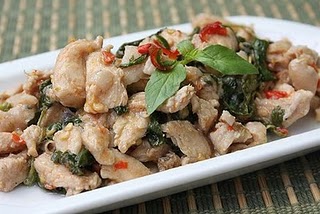
Pad Krapao : Chicken, pork or prawns stir-fried with basil.


Kaeng Phed Ped Yang : Roasted duck in spicy curry sauce.


Tom Kha Gai : Chicken in coconut soup with galangal and lemongrass.


Khao Pad : Boiled rice fried with meat, egg, onion, spring onion, coriander, garlic and tomatoes.

Moo/Gai Satae : Barbecued pork/chicken served with peanut sauce.


Gai Pad Med Mamuang : Stir-fried chicken with cashew nuts.

 
Yum : A tangy and spicy salad made with pork, beef, chicken or fresh seafood

Learning Thai Language - Part 1

สนุก - sa nook - [is] fun; enjoyable; entertaining; amusing; pleasant


ครับ - khrap - [word added by a male speaker to the end of every sentence to convey politeness] "yes"; "that's right"; "I see."


ค่ะ - kha - [word added by a female speaker to the end of every statement to convey politeness]


ไหม - mai - [word added at the end of a statement to indicate a question]


หรือ - reuu - Really?


สวัสดี - sa wat dee - Hello; Goodbye; Good morning; Good evening


สบายดีหรือ - sa baai dee reuu - How are you?


ยินดีที่ได้รู้จัก - yin dee thee dai ruu jak - Nice to meet you.


แล้วพบกันใหม่ - laaeo phohp gan mai - See you later.

Tom Kah Gai (Coconut milk soup)


Note: the following recipe is for chicken, but any meat can be substituted! Tom Kah can be served as part of a meal, or can be a meal in itself.

Ingredients:
16 oz chicken broth
4 lime leaves
2 inch piece lemon grass
1-inch piece galangal ("kah") sliced thinly.
4 tablespoons fish sauce
2 tablespoons lime juice
4 oz chicken breast, cut into small bite sized pieces
5 fl ounces coconut milk
X pinch of red chili powder
X cilantro leaves (as a garnish)
Directions:
After you have heated the chicken broth, add in all of the ingredients except for the chicken and coconut milk. Bring to a boil, then add the remaining two ingredients. Let it boil for 2 minutes, until the chicken is done, then bring it down to a simmer for a few minutes.

Green Chicken Curry

THAI FOOD Stir Fried Mung Beans