Monday, January 10, 2011

Thailand Weather

For interactive information, please refer to our animated Thai weather map -- an interactive map to the weather situation in Thailand with detailed monthly statistics on rainfall, minimum and maximum temperature and number of rainy days in a month. Otherwise, for more detailed information, including climatic charts, please read on.

Thailand can best be described as tropical and humid for the majority of the country during most of the year. The area of Thailand north of Bangkok has a climate determined by three seasons whilst the southern peninsular region of Thailand has only two.
In northern Thailand the seasons are clearly defined. Between November and May the weather is mostly dry, however this is broken up into the periods November to February and March to May. The later of these two periods has the higher relative temperatures as although the northeast monsoon does not directly effect the northern area of Thailand, it does cause cooling breezes from November to February.
The other northern season is from May to November and is dominated by the southwest monsoon, during which time rainfall in the north is at its heaviest.

The southern region of Thailand really has only two seasons -- the wet and the dry. These seasons do not run at the same time on both the east and west side of the peninsular. On the west coast the southwest monsoon brings rain and often heavy storms from April through to October, whilst on the east coast the most rain falls between September and December.
Overall the southern parts of Thailand get by far the most rain with around 2,400 millimetres every year, compared with the central and northern regions of Thailand, both of which get around 1,400 millimetres.

When is the best time to visit Thailand?

Generally speaking,the best time to visit Thailand is from November to February when the northeast monsoon is blowing cool, dry air which serves as a respite from the heat. During this cool season, the temperature ranges from 18ºC to 32ºC in Bangkok, while in northern and northeast Thailand, temperatures can get quite cool with morning temperatures as low as 8º C to 12º C with the occasional 20º C day. Nights can be particularly chilly and at high altitudes the temperatures can and do drop below freezing.
The summer period, or hot and dry season, is from March to June. At this time temperatures in Bangkok average around 34º C, but can often reach 40º C with the humidity levels of 75%.
Try and avoid April, unless you plan to be permanently submerged in the ocean, because this is the hottest month across the country.
From July to October is the monsoonal season when most of Thailand's annual rainfall is accumulated. The humidity averages just under 90%, with temperatures averaging around 29º C in Bangkok.
The monsoons finish when the wind direction changes, bringing dry weather from the northeast. At best this season can be described as unpredictable and not the constant downpour of rain like you would expect. The middle months of this season may hold particularly heavy rains for the north of the country.

Central Thailand: Bangkok


Central Thailand: Ko Chang


Northern Thailand: Chiang Mai


Northeastern Thailand: Udon Thani 


Northeastern Thailand: Buriram


South-east Thailand: Ko Samui


South-west Thailand: Phuket


South-west Thailand: Ko Lanta


South-west Thailand: Trang

About E-Sarn

Thais from the Northeast section of Thailand, Issan (or Esarn), consider themselves Lao, and historically this part of Thailand and Laos have very close connections reflected in the music, dress and of course the food. E-Sarn's chef, Ting Pathammavong, was raised there, and now she blends her own variations of recipes from her traditional land.
For over 10 years, Ting worked in the kitchen of just about every Thai restaurant in Portland before a friend suggested that she and her husband, Mao, open up their own. That was over 6 years ago, and if asked about it, Mao smiles and says he still loves it, and would rather be at work than at home. He jokingly says that when he is at home, his twin daughters play with each other, leaving him nothing to do.
When asked what makes his restaurant voted "Portland's Best," he simply says, "We use only fresh ingredients. We can't be open for breakfast, because we spend the morning buying the food for that day."
He also says he has a wonderful staff, and says, "We're really happy here. And a happy staff makes a happy customer. Some have even been with me from the beginning." It's true, his bartender, Raphael Rodriguez, was working the downtown restaurant when Mao bought the place. It is difficult to stump Raphael with even obscure drinks.
Recently, Mao's sister, Air, came over from Thailand to help him open up E-Sarn's second location just off of Northwest 23rd. When asked what the future holds for E-San, Mao said, "Well, my other sister just graduated from the Culinary Institute in Esarn, and will soon be coming over to help out." Even with multiple locations, E-Sarn is still family owned and operated.

About Thai Food

The adage of Thai cooking is simple: Cook with your tongue! In traditional Thai cuisine, recipes are more like guidelines, and each chef is free to deviate to compensate for a particular ingredient's flavor changes or to fit a new locale. In fact, many Thai chefs have difficulty with western cooking because in Thailand, there are no measuring cups.
Thai chefs learn to cook by watching and helping in the kitchen... by "internalizing the system" instead of by following written instructions. This is why you will find such a wide variation between restaurants.
Having trouble understanding that menu? Here are a few definitions of the descriptions of traditional Thai dishes:
  • Yum: literally means to mix. Meat with herbs and spices, vegetable with spices, meat and vegetables with spices mix with sauce. Some sauces are sour and spicy, some are spicy and sweet.
  • Gang Jeude: clear broth soup with vegetable or meat or both.
  • Gang Ped or Gang: spicy broth with or without coconut milk. The majority of gangs use curry paste and coconut milk.
  • Pud or Phad: vegetable or meat stir fried.
  • Tod: pan fried or deep fried, (i.e. Tod Mun is fried fish cakes).
  • Yang: grilled (i.e. Gai Yang is grilled chicken)

How to make "papaya salad - Som Tam"

How to make "pad Thai"

Sunday, January 9, 2011

Tourists' Favourite Top 10 Thai dishes

Tom Yum Goong : A spicy shrimp soup made with coconut milk, lemongrass, lime leaves, galangal and shallots.


Kaeng Kheaw Wan Gai : Green chicken curry made from green curry paste and coconut milk.

 
Pad Thai : Noodles fried with tofu, spring onions, bean sprouts and ground peanuts.

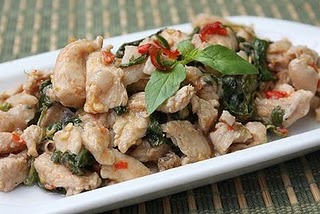
Pad Krapao : Chicken, pork or prawns stir-fried with basil.


Kaeng Phed Ped Yang : Roasted duck in spicy curry sauce.


Tom Kha Gai : Chicken in coconut soup with galangal and lemongrass.


Khao Pad : Boiled rice fried with meat, egg, onion, spring onion, coriander, garlic and tomatoes.

Moo/Gai Satae : Barbecued pork/chicken served with peanut sauce.


Gai Pad Med Mamuang : Stir-fried chicken with cashew nuts.

 
Yum : A tangy and spicy salad made with pork, beef, chicken or fresh seafood

Learning Thai Language - Part 1

สนุก - sa nook - [is] fun; enjoyable; entertaining; amusing; pleasant


ครับ - khrap - [word added by a male speaker to the end of every sentence to convey politeness] "yes"; "that's right"; "I see."


ค่ะ - kha - [word added by a female speaker to the end of every statement to convey politeness]


ไหม - mai - [word added at the end of a statement to indicate a question]


หรือ - reuu - Really?


สวัสดี - sa wat dee - Hello; Goodbye; Good morning; Good evening


สบายดีหรือ - sa baai dee reuu - How are you?


ยินดีที่ได้รู้จัก - yin dee thee dai ruu jak - Nice to meet you.


แล้วพบกันใหม่ - laaeo phohp gan mai - See you later.

Tom Kah Gai (Coconut milk soup)


Note: the following recipe is for chicken, but any meat can be substituted! Tom Kah can be served as part of a meal, or can be a meal in itself.

Ingredients:
16 oz chicken broth
4 lime leaves
2 inch piece lemon grass
1-inch piece galangal ("kah") sliced thinly.
4 tablespoons fish sauce
2 tablespoons lime juice
4 oz chicken breast, cut into small bite sized pieces
5 fl ounces coconut milk
X pinch of red chili powder
X cilantro leaves (as a garnish)
Directions:
After you have heated the chicken broth, add in all of the ingredients except for the chicken and coconut milk. Bring to a boil, then add the remaining two ingredients. Let it boil for 2 minutes, until the chicken is done, then bring it down to a simmer for a few minutes.

Green Chicken Curry

THAI FOOD Stir Fried Mung Beans


Saturday, January 8, 2011

Introduction Thai Food

Thai food is internationally famous. Whether chilli-hot or comparatively blands, harmony is the guiding principle behind each dish. Thai cuisine is essentially a marriage of centuries-old Eastern and Western influences harmoniously combined into something uniquely Thai. The characteristics of Thai food
depend on who cooks it, for whom it is cooked, for what occasion, and where it is cooked to suit all palates. Originally, Thai cooking reflected the characteristics of a waterborne lifestyle. Aquatic animals, plants and herbs were major ingredients. Large chunks of meat were eschewed. Subsequent influences introduced the use of sizeable chunks to Thai cooking.
With their Buddhist background, Thais shunned the use of large animals in big chunks. Big cuts of meat were shredded and laced with herbs and spices. Traditional Thai cooking methods were stewing and baking, or grilling. Chinese influences saw the introduction of frying, stir frying and deep-frying. Culinary influences from the 17th century onwards included Portuguese, Dutch, French and Japanese. Chillies were introduced to Thai cooking during the late 1600s by Portuguese missionaries who had acquired a taste for them while serving in South America.
Thais were very adapt at 'Siamese-icing' foreign cooking methods, and substituting ingredients. The ghee used in Indian cooking was replaced by coconut oil, and coconut milk substituted for other daily products. Overpowering pure spices were toned down and enhanced by fresh herbs such as lemon grass and galanga. Eventually, fewer and less spices were used in Thai curries, while the use of fresh herbs increased. It is generally acknowledged that Thai curries burn intensely, but briefly, whereas other curries, with strong spices, burn for longer periods. Instead of serving dishes in courses, a Thai meal is served all at once, permitting dinners to enjoy complementary combinations of different tastes.
A proper Thai meal should consist of a soup, a curry dish with condiments, a dip with accompanying fish and vegetables. A spiced salad may replace the curry dish. The soup can also be spicy, but the curry should be replaced by non spiced items. There must be a harmony of tastes and textures within individual dishes and the entire meal.

Learning Thai Manners 4

This is the final part of the Thai Manner demonstration at Sriwittayapaknam School. In the previous blogs, I told how this family went to visit their grandmother. After prostrating on the floor, the grandmother then invites the two adults to sit on the chairs next to her. Notice that the two children are sitting on the floor. This is quite a common setup in Thailand. You must always remember the level of your head. As a teacher, it is not advisable for us to sit on the floor in the classroom. You can, if you like of course, but it would make it awkward for the children to walk past you. Even other teachers would try and stoop down as low as they can to walk past you. They are doing this to show respect to your status or age

In this second photo, the daughter gives her grandmother a basket of fruit. As her grandmother is seated, she cannot just walk to her. She must go on her knees. Then she presents the basket with both hands. Later, her cousin brings some drinks for everyone. As she is younger than the adults, she too walks on her knees. She first serves the adults, starting with the grandmother. The adults smile and nod in acknowledgement. However, as the daughter is younger than her cousin, she first gives a “wai” before taking the drink.

Now it is time for them to go home. This time they do the “seated wai”. Much like the others I described before. Hands are brought up to chest level and the head bows down towards them. Notice the grandmother is just doing the “receiving wai”. This is the proper way for her to show respect back to the younger people. However, I have sometimes seen a few people who are so full of their self-importance that they only acknowledged an adult’s wai with a nod. In my books this is bad manners. If an adult wais you, then you must wai them back. The only people who don’t wai you back is the king and monks. And the monks won’t wai the king back. That is how important religion is in Thailand.

The family now leave. The grandmother is still seated so notice how they need to dip their head as they walk away. As an adult, you don’t need to lower your head literally lower than the senior person in the room. You just need to make that effort. Tall foreigners will be glad to hear that. One final thing I forgot to point out earlier. Many of you probably know this anyway. When you enter homes in Thailand you must first take off your shoes!

Learning Thai Manners 3

This is continuing with the story of the parents that took their daughter to visit her grandmother. Arriving at the front door, they are greeted by their niece. As she is a lot younger than them, notice how much more respect she is showing to the two adults. For them, all they have to do is a “receiving wai” as their niece is still a child.

The mother then turns to her daughter and tells her to say “hello” to her cousin. As they are not of similar age, the younger cousin has to pay more respect. Notice that the niece, who is probably about 3 or 4 years older, is just doing the receiving wai. However, the daughter, being the youngest, has to do a full and deep wai. If the two children were of the same age then they would only need to do the standard straight wai without the courtesy.

Now they are shown into the presence of the grandmother. She is probably the eldest of the family and so therefore the matriarch. Everyone has to pay her the greatest of respect.  Notice how they are all approaching the grandmother. They are doing this on their knees because she is seated. It is important that their head is not higher than that of the grandmother. Notice also how the niece is sitting respectfully off to one side
Now they entire family are doing the respectful “seated wai”. You saw some close-ups of something like this the other day. See how they are not actually kneeling but sitting on the left leg. They then bow down to the floor with both the hands and elbows touching the surface. This is, of course, very different to how Thai people pay respect to a Buddha image. I showed you those pictures the other day. With a Buddha image they would kneel and then prostrate to the ground with their hands flat on the surface in front of them.

Learning Thai Manners 2

Today I am going to continue with some examples of good Thai manners which I see a lot in every-day situations. The pictures today illustrate how to behave at home and when visiting relations and friends. In the above picture, a daughter is talking to her parents. Notice, that as her parents are seated, it is proper protocol for her then to kneel on the floor while talking to them. The head, in Thailand, is considered sacred and you have to be aware at all times which level it is in relation to people your senior. You saw in my previous blog how the students would dip their head as they walked past an adult or teacher. It doesn’t matter if you are walking in front of them or behind. You still need to make an effort. As a tall foreigner, it isn’t always possible to dip your head lower, but you need to at least make the effort to lower your head.

In these second set of photos, the family have gone out to visit the grandmother. On the way they bump into an adult friend of the mother. Notice how the adults wai each other. In this situation, between peers, you bring your hands up to chest level and bow your head down to meet them. The woman doesn’t have to courtesy which you saw in earlier pictures. This is a proper wai. However, in daily life, many people do what I call a “lazy wai”. They bring their thumbs up to about nose level and do not bow. Just don’t forget, whenever you “wai”, always do it in a graceful manner. Never make any quick jerky movements.

After the adults have greeted each other, the mother turns to the daughter to introduce her adult friend. This time the age difference is more important. The daughter has to pay more respect to the person older than herself. Notice how she does a deep bow and a courtesy at the same time. You cannot see in this photo but the adult is doing a “receiving wai”. He does this by bringing his hands up to chest level like before but this time he doesn’t bow. It is quite important for you to realize that you should never “wai” a child first. At school, when the students “wai” the teachers, we usually just smile and nod back as acknowledgment. The students in our school are all quite young. However, if one of my ex-students comes to visit me, then I give them a “receiving wai”. Though usually I will raise the hands a little higher to about nose level in order to show them a bit more respect.

Learning Thai Manners 1

These pictures were taken at Sriwittayapaknam School in Samut Prakan. The students were taking part in a competition for Thai Manners. In this first set of pictures, the students are demonstrating the proper way to show repsect to a Buddha image. This is done in three stages.

In the top picture, the students first kneel down in front of the Buddha image and bring their hands up to chest level. They then bow down bringing their head towards their hands. They pause here for a second. Next they go all the way down placing their hands flat on the surface. This is then repeated three times.

In this second group of photos, the students are demonstrating how to receive a gift from an adult. First they sit on the floor with their left leg tucked under the right one. They then prostrate down to the floor with their hands together in a prayer-like gesture. Notice the position of their elbows on the ground.
This is then held for a few seconds before the hands are clasped together like in a handshake. Next they sit back up straight with their hands on their laps.

To receive the gift, the left hand stays on the thigh and the right hands reaches forward to receive the gift. Like any movement, this has to be done gracefully. They reach out to hold the gift, pause, then bring it back. They don’t just grab it. This gift is then put down on the right-hand side. The students then prostrated to the floor again as in the above photos.

Top 10 Thai Street Food


For the last week or so I have been trying to think of my Top 10 for Thai street food. One of the good things about living in Thailand is the easy availability of some of the best food in the world. But this leads to my difficulty of being able to list a top 10. So, what I will do over the next few weeks is produce a "nomination" list first.

The criteria for the first list is food served on the street just around the corner from where I live! I have only included meals, so none of my favourite snacks and no desserts yet. You also won't see any ready cooked food so no curries on the list. All of these will come later.
Here is the list in no particular order:
1. som tam - a spicy salad with shredded papaya
2. khao mun gai tod - fried chicken served on rice cooked in chicken broth
3. rat naa - noodles and pork in a thick gravey
4. ba mee nam - egg noodle soup with wonton
5. pad thai - fried noodles with dried shrimp and tofu
6. jok - a thick rice soup excellent for breakfast
7. pad see iew - pan-fried noodles
8. khao pad - fried rice
9. moo pad krapow - pork fried in basil
10. khao moo daeng - red pork with rice


Well, that is the first attempt. Just reading through it is making me hungry! I will be posting more nominations soon. I will also be going through the list one by one with pictures of the foodstalls and finished product. I will be attempting to cook some of them so I will also be giving you some recipes.

Thailand School Lunch Menu

Tom Yum Gai - Lemon Grass Soup with Chicken

Today I am giving you the full menu for our school lunches. This is what the students eat over a four week period. There are actually three different menus: kindergarten, junior school and senior school. As there are some repeats I will just give you the menu for the older students. Not everyone eats the same thing at the same time. There are 1,800 students (and one small kitchen) so not everyone can have a rice based meal at the same time. So, half of the school have rice while the other half have some kind of soup. I will show you the kitchen and rice-cookers later.


Khao Mun Gai Tod - Fried Chicken on Rice

The following is the menu for the senior school:
Fried chicken with rice
Green curry with pork + cucumber with egg
Fried pork and basil on rice + chicken with fried garlic
Egg noodle soup with wonton
Rice porridge with pork
Macaroni soup
Fried rice with egg and mini sausages
Lemon grass soup with chicken + bamboo shoots with egg
Fried chicken basil + Tang-lan soup
Stir fried bamboo + Chinese sausage
Fried pork basil + omelet
Chicken curry with bamboo shoots + stir-fried cabbage
Fried thick noodle in soy source
Fried chilli with pork and long-beans + fried sausage
Noodle soup with steamed pork
Rice porridge with chicken
Orange curry + omelet
Chicken on rice
Noodles in thick gravy
Red pork with rice
I think my favourites out of this are: lemon grass soup (tom yum gai), fried chicken with rice (khao mun gai tod), egg noodle soup with wonton (ba mee nam), green curry with pork (gang kee-o waen moo), chicken curry with bamboo shoots (gang gai sai noh mai) and probably quite a few others. Before I give you the Top 10 School Lunches as voted by the students, what do you think will be their favourite meals?